A key step to end corporate impunity: the potential of the Catalan Centre for Business and Human Rights
Engineering Without Borders presents a new legal report analysing how the future Catalan Centre for Business and Human Rights can strengthen access to justice, corporate accountability and the protection of human rights.
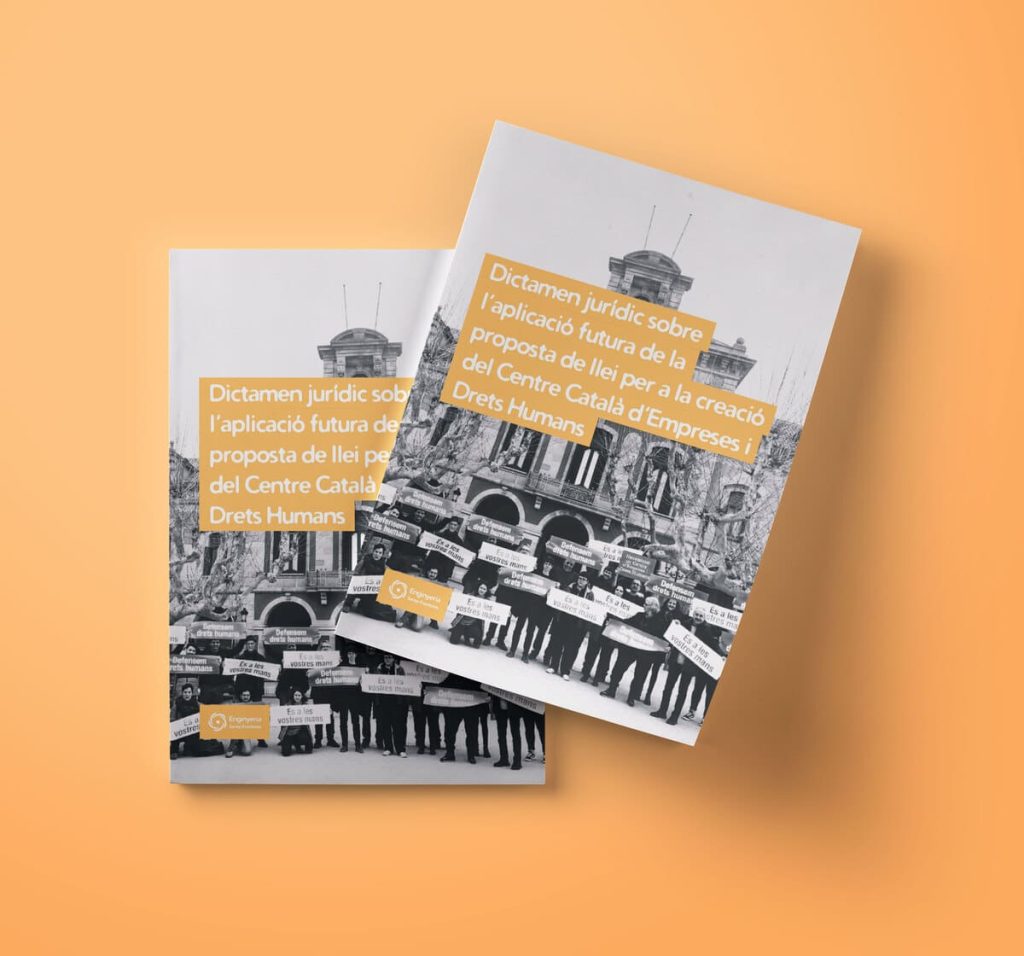
Engineering Without Borders (ESF) has published a new legal report on the future implementation of the proposed law to create the Catalan Centre for Business and Human Rights (CCEDH). The document, promoted by ESF and authored by Alejandra Durán Castellanos, member of the cooperative CICrA Justicia Ambiental, provides an in-depth analysis of the Centre’s potential as a public mechanism to address human rights and environmental violations linked to business activities.
In a global context marked by extractivism, the climate crisis and the ongoing impunity of transnational corporations—especially in the Global South—this report positions the CCEDH as a key tool to advance policy coherence, corporate accountability and effective access to justice for affected communities.
At a time when the Parliament of Catalonia is moving forward with the creation of the Centre, the report gains particular relevance: it provides legal tools and concrete proposals to ensure that the future Centre is effective, independent and capable of generating real impact, and to position Catalonia with a pioneering mechanism in Europe.
A context of impunity that demands bold public responses
The study starts from a clear diagnosis: human rights violations by transnational corporations remain structural and systemic, despite the existence of international and European due diligence frameworks. Current mechanisms—often based on voluntary standards or obligations of means rather than results—are insufficient to guarantee reparation, accountability and effective prevention. In this scenario, the CCEDH emerges as a unique proposal in the European context: a public, independent body driven by civil society, with the capacity to prevent, investigate, assess and monitor the overseas activities of companies operating from Catalonia.
What does this report contribute?
The report provides a comprehensive analysis of the current legal framework on business and human rights at international, European and state levels. It examines the debate on due diligence and the European CSDDD Directive in light of their limitations, and contrasts them with more ambitious proposals such as the UN Binding Treaty.
Building on this context, the study explores the added value that the Catalan Centre for Business and Human Rights could bring compared to existing mechanisms, such as the OECD National Contact Points, experiences in countries like Germany or Denmark, or the national supervisory authorities foreseen by the Directive. It highlights what makes the Centre truly distinctive: its ability to investigate specific cases, oversee corporate conduct abroad and directly hold public authorities accountable.
The report also examines in depth the potential of the CCEDH to strengthen access to justice and reparation, through case investigations, the publication of public reports and enhanced corporate accountability for companies operating in Catalonia.
Finally, the document identifies key challenges that must be addressed to ensure the Centre’s effectiveness and independence, including governance, sanctioning powers, complaint procedures and guarantees of accessibility and safety for affected communities.
From theory to practice: the El Quimbo case
One of the most relevant contributions of the study is the practical application of the CCEDH proposal to the case of the El Quimbo hydroelectric project in Colombia, a paradigmatic example of severe impacts on human rights, the environment and local communities in the Global South.
Drawing on collaboration with the organisation Asoquimbo, which represents affected communities, the report shows how the future CCEDH could intervene: from receiving a collective complaint to conducting in-depth investigations, requesting information from the company and issuing a report with reparative and political impact.
This case highlights the importance of ensuring that the CCEDH is accessible, safe and useful for communities, particularly for human rights defenders facing threats, criminalisation and lack of transparency.
An essential tool at a critical moment
In a European context where corporate transparency and accountability requirements are being weakened, this report concludes that the CCEDH is not only viable, but necessary. Not as just another technical body, but as a public mechanism with real capacity to drive change, placing human rights and environmental justice before corporate profit.
👉 This study aims to contribute to the parliamentary and public debate, providing legal and political arguments for Catalonia to take a step forward in the fight against corporate impunity. Download the full report (in catalan).